
Being Your Team's "AI Person" Isn't The Win You Think It Is
Why solo champions will lose and how to stand out by becoming a multiplier instead.


You've been advancing with AI for months now.
Learning and experimenting, and finding patterns that have clear returns.
But you're doing it solo.
Your team isn't asking questions or showing interest.
Instead, they're waiting to be told what to do.
And you become the go-to person.
Maybe you're on the AI task force, or maybe you got voluntold to lead AI transformation for your team.
Now you're carrying the load on top of your day job.
You're figuring it out on the fly and translating AI into potential workflows because no one else can.
Leadership thinks your team is crushing it because they only hear from you and the task force.
Meanwhile your team is completely lost...
Being the "AI person" can seem like a personal advantage.
But here's the 10x opportunity that will make you stand out even more:
Using your leadership position to enable everyone.
You're probably thinking that there's only so much you can do.
The team already took training, but shocker... the 40/100 proficiency they got from it isn't enough for transformation.
The solution? Support and empowerment.
Giving others a better understanding, permission, time, expectations, and the space to build their own solutions.
When your team gets there, you become a multiplier.

Being a Solo Champion is Risky
Here's what leadership thinks is happening:
Transformation is underway, teams are upskilling, AI is being adopted across the organization.
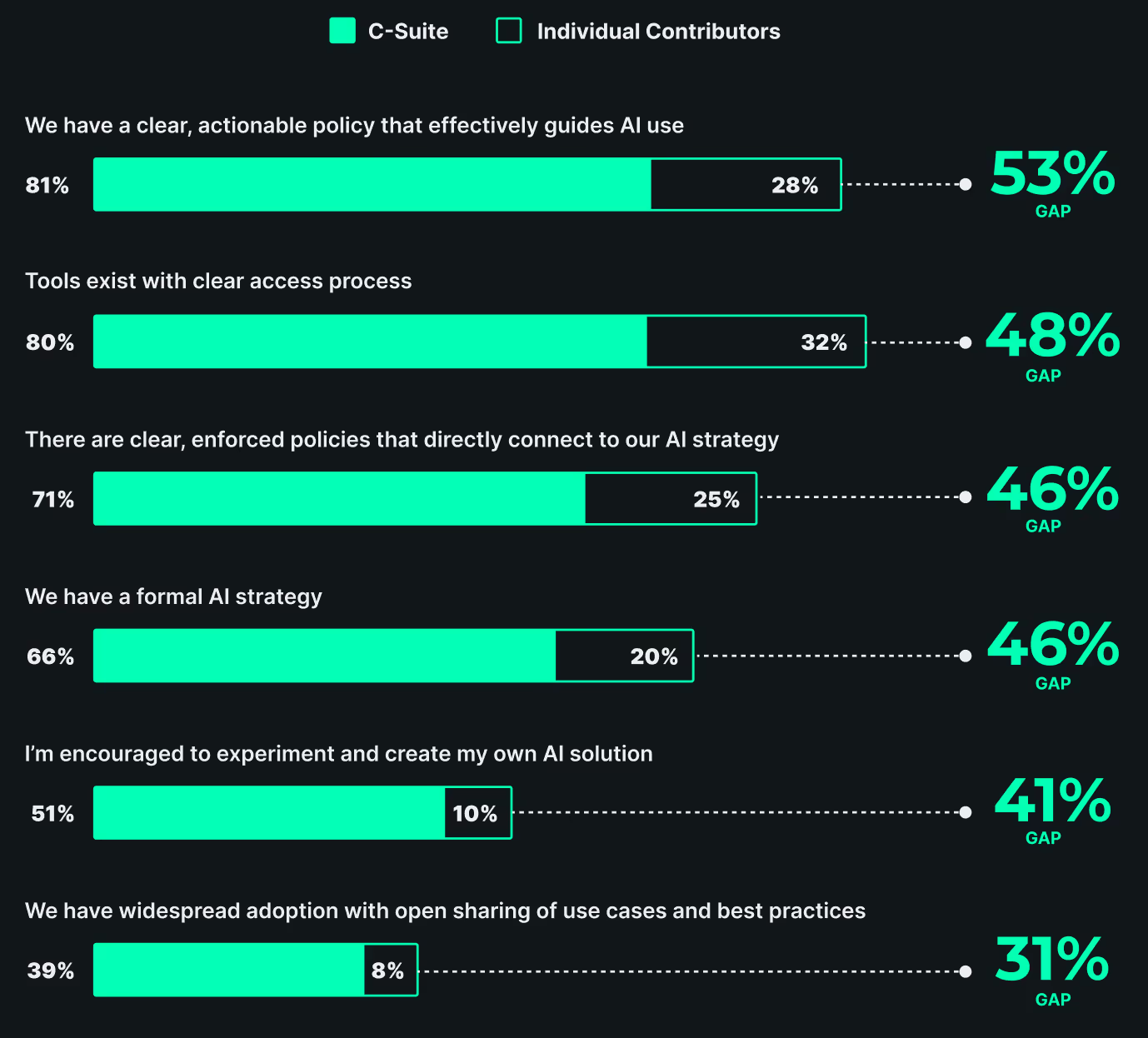
They think they have clear policies, accessible tools, and employees who are encouraged to experiment.
Plus you look good because you're leading change.
Here's what's really happening:
The perception gap between C-suite and individual contributors is massive (ranging from 31% to 53% depending on the question).
And beyond what leadership can see, 97% of the workforce is using AI poorly or not at all.
At some point, leadership is going to realize the rosy picture you've been painting doesn't match reality.
And there's an even bigger issue:
While you're progressing, your team is getting left behind, and the divide is growing fast.
Right now, the gap is closeable.
AI is still emerging, people can still catch up if they get the right support.
But if you wait, that window closes.
People who get proper support now can start building systems and redesigning workflows.
While the ones who don't will be completely unaware and falling further back every day.
By knowing this and not helping your team now, you're actively setting them up to fail in the future.
And you're also putting your organization at risk.
It's only a matter of time until competitors with working AI solutions jump ahead.
Your company won't be able to compete if it's just you and the task force driving change.
This is how your advantage becomes a trap if you don't amplify it.
Why Your Team Isn't Upskilling
Your team isn't refusing to learn.
The system just isn't set up to help them.
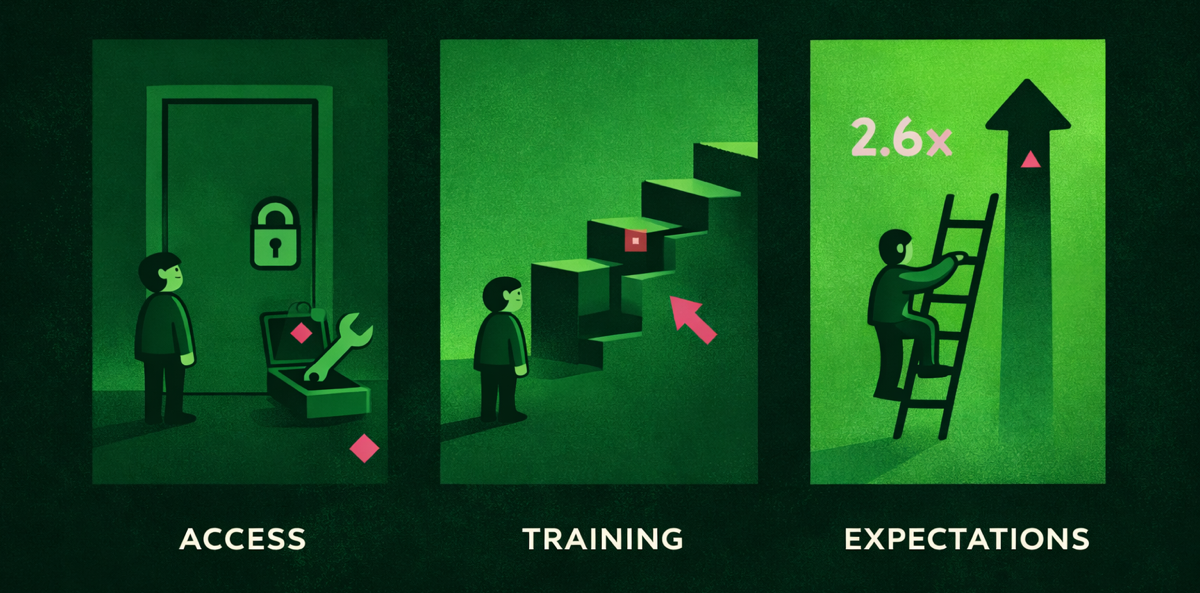
Three barriers holding them back:
1. Access
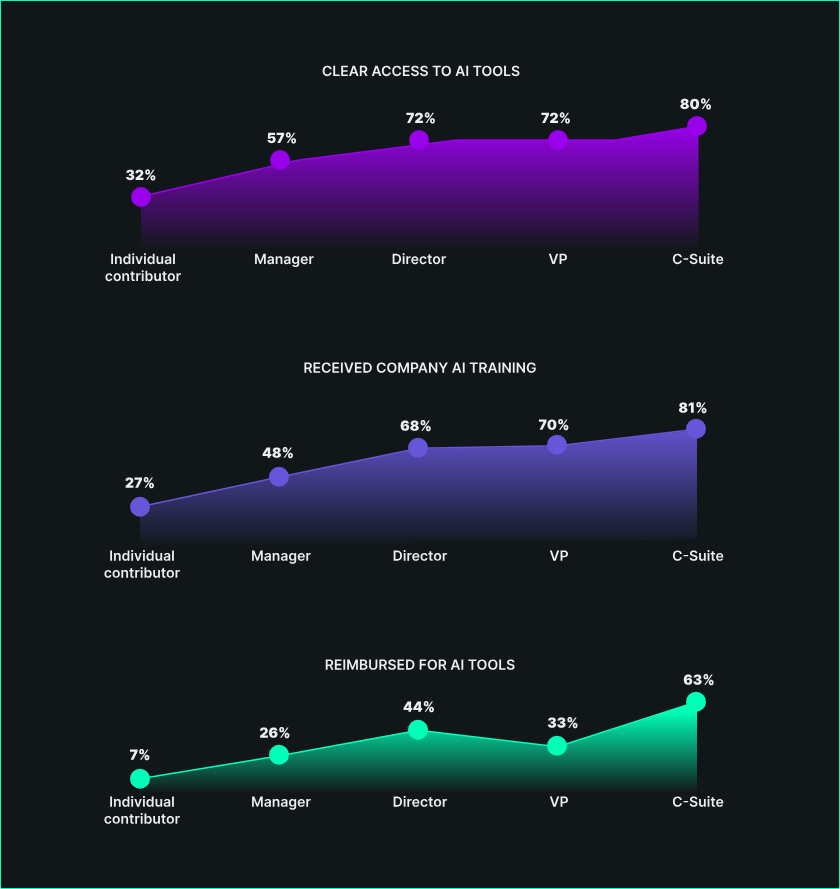
Individual contributors have the least access to AI tools, the least support from leadership, and the lowest manager expectations.
They're supposed to transform their work with tools they barely have permission to use.
2. Training quality
66% of organizations say they intend to provide AI training, but only 37% have given their teams actual access.
And even when teams get training, it teaches them to do the most basic stuff.
Not the stuff that's going to drive transformation like guiding them to create their own solutions, redesign workflows, or transform their role.
3. Manager expectations
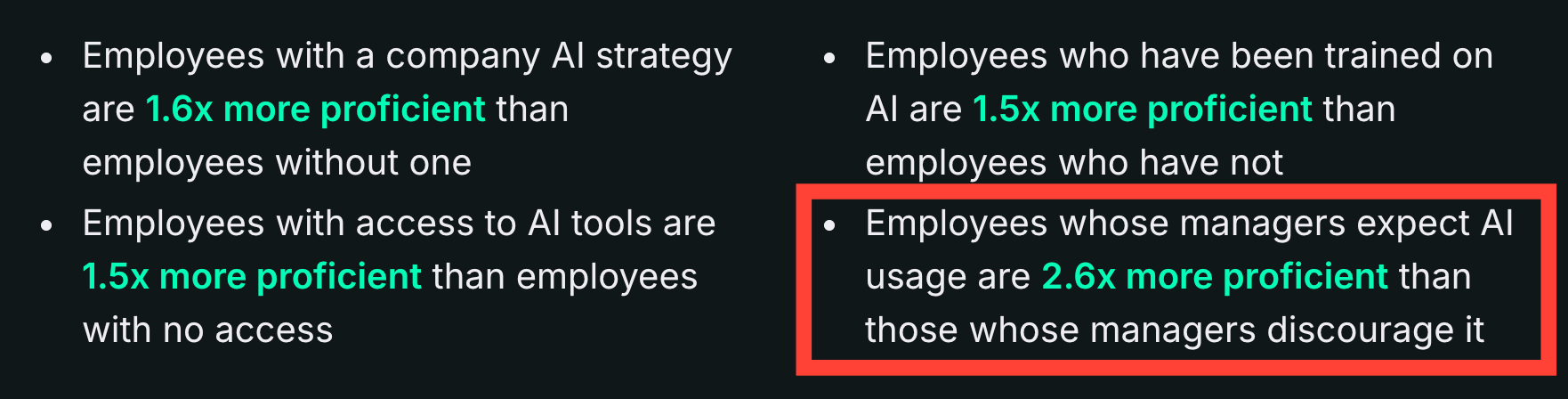
Manager expectations drive proficiency 2.6x more than tool access or training alone.
Your team has access to tools, they might have had training too.
But if you're not setting expectations, giving them permission to explore, and creating space for them to build, they won't move beyond surface-level use.
Becoming the Multiplier
Okay, this isn't all doom and gloom.
You are a bridge that can turn things around.
Here's the path:
1. Uplevel baseline proficiency.
Go beyond basic training.
Get your team to understand AI well enough to see where it connects to their workflows and how to build solutions.
Your full team can reach this level with proper support. I've seen this type of transformation happen for the teams I work with.
Your individual team can do this now. You don't have to wait for your full organization to figure out that the support they provided wasn't enough.
2. Give your team the conditions to build.
Give them time, permission, clear expectations, resources, and the responsibility to identify where AI should fit in their roles or processes.
Make spending time building with AI part of their role.
Instead of "here's what you should do with AI", lead with "here's time and space to figure it out, come back and show me."
3. Have them work together.
Once they start developing their own solutions, make sure they're collaborating with each other.
Sharing what they've created, holding ideation sessions, talking about what's working and what isn't.
Prioritize big projects together and gain buy-in from a team who's co-architected your roadmap.
4. Fix the foundation as you go.
Don't wait for the perfect conditions to get started.
Data, governance, tool access, and security limitations will all come up.
Once you start moving, you'll be better suited to create solutions that align with the strategies your team is building out.
5. Measure what's working.
Track role-specific use cases, the ability to build their own solutions, and whether people are moving from experimenting to transforming their work.
For measurable stats, focus on things like hours saved, error reduction, quantifiable business outcomes (creative performance, ROI, etc.).
Avoid measuring AI success by the number of people using the tool.
Why This Approach Works
Research shows that isolated, tactical AI projects often don't deliver measurable value.
Returns come from enterprise-scale deployment with strong organizational foundations.
Orgs achieving both additional revenue and lower costs? Only 1 in 8.
They are applying AI extensively across different areas of the business.
This can only happen when your whole team has the capability to build solutions in their domain.
Source: PwC CEO Survey
While standing out with AI might be an advantage now, that play is a losing strategy long term.
When you help your team level up, you become a multiplier.
This is how you help your company thrive and stand out over time.

Not a subscriber yet? Join here for weekly insights on AI, strategy, and the changing workplace.
Found this useful? Forward it to a teammate who's figuring out AI too.