5 Things You Should Know in AI This Week — December 12, 2025
Simplifying the noise. Here are five signals that matter for non-technical workers.


What Happened This Week

Try the interactive version →
1. OpenAI Releases GPT-5.2 After "Code Red"
Last week we covered OpenAI's internal "code red" after Google Gemini 3's strong reception.
The leaks were true.
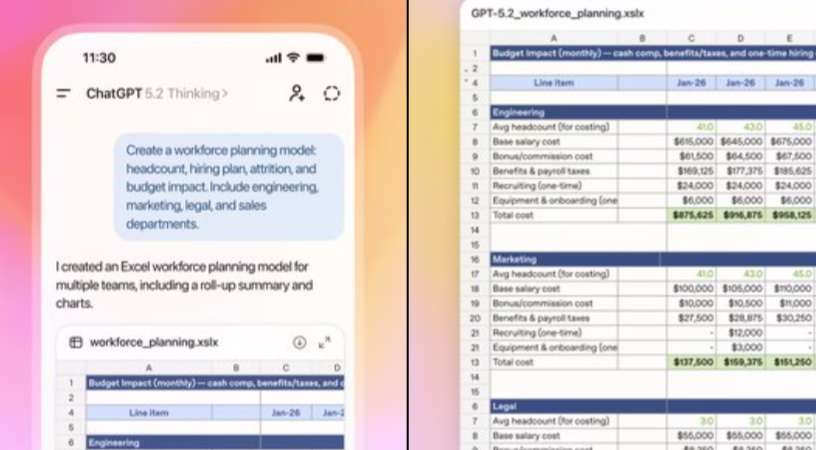
OpenAI released GPT-5.2 on Thursday.
Their "most advanced frontier model for professional work and long-running agents."
It's a new hybrid model focused on advanced reasoning, with three modes:
- Instant: "Warm and conversational", speed-optimized for routine use (ex: writing, info, translation)
- Thinking: Complex tasks like coding, analysis, spreadsheets and slide show creation
- Pro: Max accuracy for programming and science
The model shows improvements in vision abilities, science, and math.
It's gradually rolling out now starting with paid plans and will become ChatGPT's default model.
GPT-5.1 will still be available for paid users for the next three months.
The signal?
OpenAI is doubling down on the enterprise play.
They're targeting devs and businesses that need reliable, production-level AI for work.
That's where $$$ and longevity are.
For most users, you probably won't notice dramatic differences in everyday use.
This release is about fundamentals (capability, speed, reliability).
2. Disney and OpenAI Strike $1B Licensing Deal
Disney and OpenAI just announced a three-year partnership.
Disney's investing $1 billion in OpenAI equity and licensing its characters for video and image creation.
Users will be able to create Disney, Pixar, Marvel, and Star Wars content through OpenAI's Sora and ChatGPT image gen tools.
Disney will also use OpenAI's models for Disney+ experiences and their internal employee tools.
It's one of the first big entertainment licensing deals of this size.
Meanwhile, Meta signed multiple licensing agreements with news pubs this week (CNN, USA Today, Fox News) to show news through their AI experiences.
And The New York Times sued Perplexity for allegedly copying millions of paywalled articles without permission.
Different approaches, but the same pattern is unfolding.
The signal?
We don't talk enough about how AI will fragment like streaming in the near future.
AI companies are signing content and usage deals weekly.
When a company like Disney locks in with OpenAI for three years, they'll likely get stricter about where and how their content shows up across other AI platforms.
Three years is a long time in AI days.
As more brand partnerships get signed, we'll probably have to go to specific platforms for specific content.
Just like you use Netflix for some shows and Apple TV for others.
Early days, but that's the direction this is headed.
For brands: the landscape is shifting from the Wild West of content to structured deals.
That's good news for clarity.
But don't rush into exclusive partnerships when the AI landscape could look very different in 18 months.
As more deals get ironed out, guidelines will get clearer on when and how to legally use AI for content production.
3. Google's Taking Another Shot at Smart Glasses
Remember Google Glass?
Google's failed attempt at smart glasses from about a decade ago that ended up being more of a punchline than a product.
They're trying again.
Google plans to launch AI-powered smart glasses in 2026, built on Android XR and powered by Gemini.
They're partnering with Warby Parker, Gentle Monster, and Samsung to make them.
Two types:
- Screen-free glasses with speakers, mics, and cameras for hands-free audio interactions
- Display glasses with an in-lens screen for nav, translations, and captions
Their competitor, Meta, has already gone all-in on smart glasses with their Ray-Ban partnership, even running a Super Bowl ad this year.
Apple tried with their more immersive Vision Pro headset last year too, but that didn't take off like people expected.
Now Google's jumping in with Meta's more practical play.
Unlike standalone AI gadgets, Google's glasses will use Android phones as the computing hub (similar to Apple's watch + iPhone pairing).
For Google, this means slimmer frames and lower cost glasses.
It also extends their product ecosystem.
The signal?
Another big player is betting that smart glasses are the future of AI.
Privacy concerns and social awkwardness are a barrier though.
It's unclear when (or if) we'll hit the tipping point of acceptance.
On the other hand, while smart glasses might feel invasive socially, they could be really useful in work settings.
Amazon recently released smart glasses for delivery drivers.
For field work, maintenance, healthcare, etc., environments hands-free instruction and real-time info would be incredibly valuable tools.
As AI vision capabilities keep improving, glasses could become a true companion based on what you're seeing.
Nothing to do right now, but it's an emerging category worth watching.
4. Meta's Building New Closed Model to Release in 2026
Meta's developing a new frontier model called "Avocado."
It's targeting a Q1-spring 2026 release.
This is a big shift.
Meta spent years positioning itself as the open-source AI alternative with Llama.
Now they're focused on a closed model.
The pivot happened mid-year after Llama 4's lackluster release.
Meta realized open source wasn't winning commercially against OpenAI, Google, and Anthropic.
So they changed their strategy: hiring top AI leaders, signing a $5 billion NVIDIA chip order, and building an AI super team to compete at the frontier level.
Avocado was originally planned for late 2025, but the delay to 2026 is probably smart.
Meta can't afford another release that doesn't impress.
They need to get back in the conversation with the big players.
The signal?
Meta was a trusted name in corporate AI about 18 months ago.
They've completely lost momentum since then.
If Avocado delivers, Meta has an advantage no one else does: distribution through Facebook, Instagram, and WhatsApp.
They already have AI features sustaining their consumer apps.
But a strong model would let them recapture enterprise credibility too.
This is just something to watch right now.
Expect Meta to re-enter the AI conversation and potentially your company's consideration set for AI partners next year.
The AI landscape can change quickly.
5. Numbers Worth Knowing This Week
- ChatGPT was the most downloaded free iPhone app in the US for 2025.
- It beat Threads, Google, TikTok, WhatsApp, and Instagram, up from #4 last year.
- Source: eWeek
- 75% of surveyed workers say AI improved their productivity.
- That's from OpenAI's first "State of Enterprise AI" report covering 9k workers across ~100 companies.
- Companies that successfully integrate AI see 1.7x revenue growth and 3.6x greater shareholder returns.
- Source: OpenAI
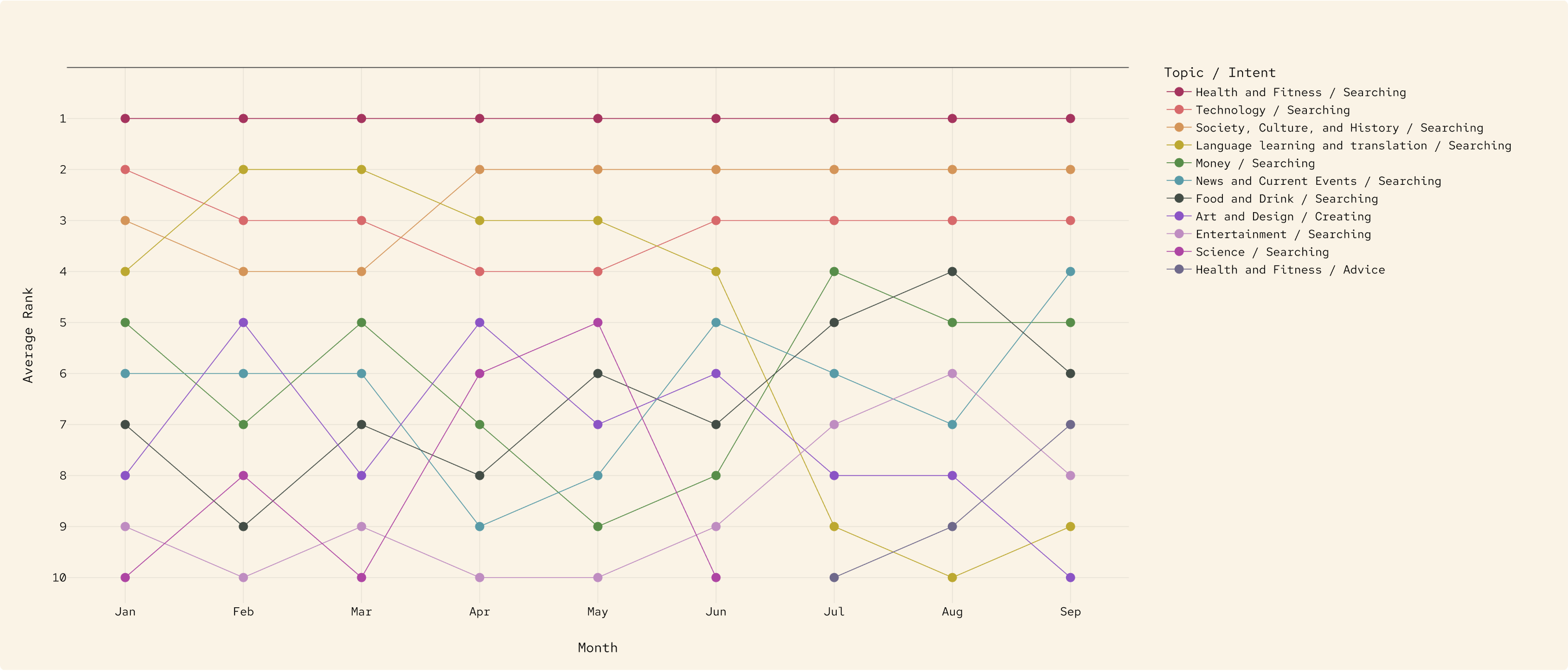
- Microsoft analyzed 37+ million Copilot conversations to see how people use AI.
- Health and wellness topics dominated mobile.
- Advice-seeking grew throughout the year, with users increasingly going to AI for guidance beyond info.
- Source: Microsoft
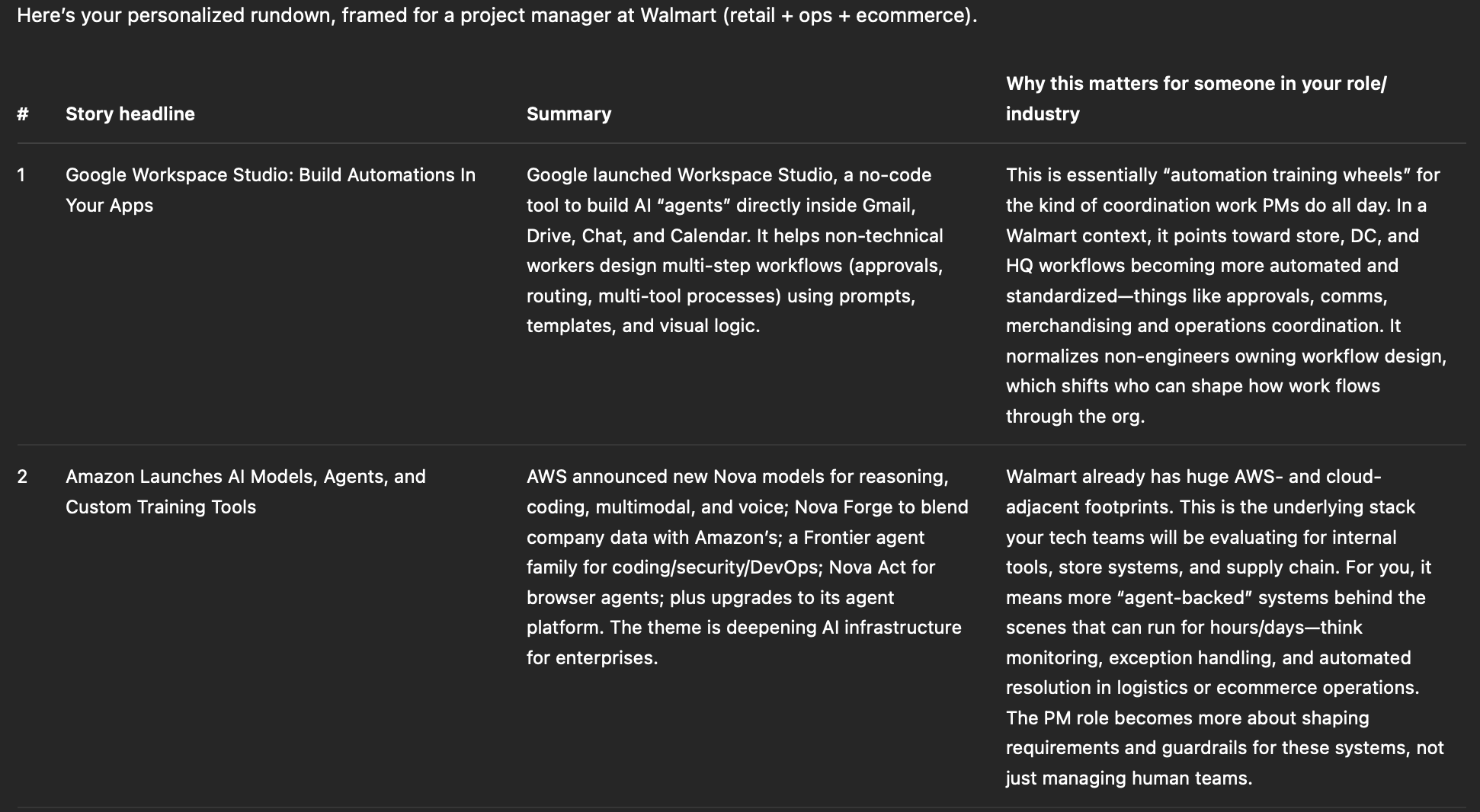
Turn This Newsletter Into Your Personal Briefing
See exactly how each story impacts your role and industry
Button not working? View on website

This week's issue is another example of how quickly the AI landscape is changing.
OpenAI racing with their latest release to respond, huge brands making exclusivity deals, Meta abandoning open source to re-enter the conversation.
Everything is shifting weekly and will probably look very different in six months.
Here's to another exciting one next week.
-Riley