40 Things I Learned From a Year of Building
Lessons about the realities of execution, patience, and momentum.

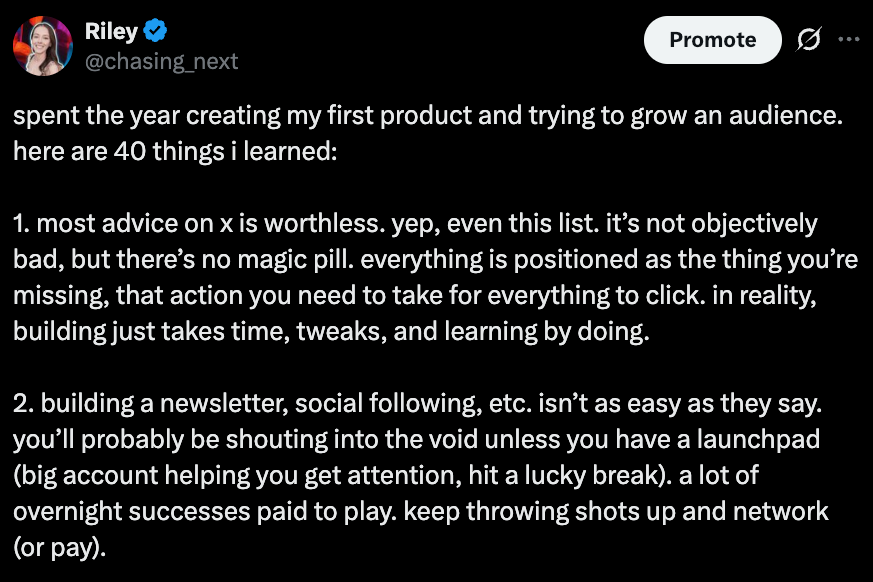
Spent the year creating products and trying to grow an audience.
Here are 40 things I learned:
- Most advice on X is worthless. Yep, even this list. It’s not objectively bad, but there’s no magic pill. Everything is positioned as the thing you’re missing, that action you need to take for everything to click. In reality, building just takes time, tweaks, and learning by doing.
- Building a newsletter, social following, etc. isn’t as easy as they say. You’ll probably be shouting into the void unless you have a launchpad (big account helping you get attention, hit a lucky break). A lot of overnight successes paid to play. Keep throwing shots up and network (or pay).
- Social media will make you feel behind. You’re only behind if you’re not taking action.
- The people you see crushing it are putting in an insane amount of effort. Even if they’re selling quick fixes or a relaxed lifestyle.
- Just because something doesn’t hit, doesn’t mean it wasn’t worthy of it. Luck is important. Keep trying stuff. Something will work, even if it wasn’t the thing you think should have.
- Not everyone can start a business. You have to love it or you’re done for. It’ll eat your energy and your mindshare. You’ll have sleepless nights and less free time (not more). You have to be at least a little crazy to turn an idea into reality.
- You’ll doubt yourself. A lot. Especially if you’re used to getting positive feedback from school or work. Feedback is hard to come by when you’re on your own. Results are slow. No one cares about something awesome you made. It can be a lonely road. This is normal.
- Your mind will fixate on how to make things take off. An endless loop of problem solving about your business, things to test, things you need to do. It won’t shut off until you get enough validation that you’re heading in a solid direction (even then I don’t think it ever stops). This will make you less present, since your mind is stuck in figure-it-out mode more than you’d like it to be.
- You’ll be tempted to go back to a stable job. Those LinkedIn listings start looking real good. People will reach out with opportunities right when things are about to lift off. Consistent money and coworkers are underrated. Going solo gave me even more respect for people who work on a team. They’re just two different paths.
- It’s important to make time for mindlessness. You’ll feel like you need to work or be productive over relaxing. Less time mindless scrolling, show watching, or doing stuff that doesn’t move you towards your goal. That show or podcast that turns your brain off is gold. The people who can pull you out of your head deserve even more of your attention.
- If you don’t choose to rest, your body will choose for you.
- Don’t rush into an idea. Spend a good amount time assessing your path before you pursue it. Really research the audience, competition, opportunity. Get clear on the value you bring. Be honest if it’s something you want to commit to for the next year plus.
- Let your ideas breathe. Everything will sound amazing in the moment, but give it a week and you’ll wonder why you thought it was worth pursuing. If you still think the idea is valuable after some space, it probably is.
- Once you land your idea, stay in your lane. This isn’t to say you shouldn’t follow opportunity as it comes, but don’t ditch one thing for the next. Everything looks better before you start.
- Have a clear goal, but make sure it’s not too specific. Instead of A to B, your journey may take you from A to C, which can be even better if you’re open to drift.
- Don’t be afraid to change your mind about stuff. Switch your position. Change your stance. Stop doing things you committed to strategically if they’re no longer serving the larger goal. Cut what’s holding you back.
- The most frustrating thing is the gap between your taste and what you’re able to produce. As you learn, you’ll know what you need to do, but won’t quite be able to deliver at the level you want to. Ship anyway.
- If you’re making something good, the final 10% to get it live really is 50% of the work. Everything takes longer than you think. A million things will come up you hadn’t even thought of. Factor this into your deadlines.
- You’ll never get to all the things you want to do. You probably shouldn’t anyway. See #1 and #13.
- Product or distribution first doesn’t matter since neither are easy. You could spend a year building an audience that never materializes or have an audience that doesn’t know you as a person they’d buy from. Do whatever is most likely to get you results based on your strengths and momentum.
- It’s extremely hard to get customers. Even when your product has results. Building trust takes time and reps. Tap into your existing network or draft off the credibility of others early on.
- You’ll spend a lot of time on admin the first year of your business (banking, accounting, licensing, health insurance, retirement, tax strategies, etc.). Most of this runs itself by year two.
- Systems are great to get going, but overstructuring can box you in and waste your time. Blow them up if they start becoming busy work or are holding you back from opportunities.
- There are so many SaaS tools that you can use for free or on cheap paid plans. Stipe, n8n, Notion, Kit, Ghost, QuickBooks, Tally… my products are basically a bundle of other SaaS products behind the scenes. For tools you use regularly, switch to the annual plan to save some $$. AI is great at helping you evaluate which tools to use.
- Public preference for AI models and tools changes week to week. Don’t get caught in trends. Most people are just parroting each other rather than offering actual takes. Follow a few people you trust, use what’s giving you results, test out stuff when it makes sense, and tune out the noise.
- Make internet friends. Many of your IRL friends won’t relate to your journey (even if they try their best). Being able to talk with people on a similar path will keep you sane.
- Connect with people one step ahead of you. They are most likely to support you and lend a hand along the way.
- No one cares about your product, what you’re posting, or what you’re up to. People who’ve supported you in the past will be silent. Don’t take this personally. Everyone is busy. Do the thing anyway.
- Having a safety net of savings helps a lot. Pressure to deliver strains creativity and makes every day harder to execute.
- Hormozi talks about playing the long game. Expect results to take more time and require more effort than you think they will. Have a plan for how to stay in the game and commit to pushing through when it gets tough.
- You’ll have months where nothing happens and weeks where everything does. When those weeks hit, you’ll think it’ll keep going up, but things will most likely dip again. This is just part of the game. Sliding back doesn’t mean you went off track. Give it time for that upward slope to reemerge.
- Read The Dip by Seth Godin.
- Failure doesn’t exist when you’re trying. You’ll learn more by doing than you ever will learning. That said, you need to know where to go and what to focus on. Smart action requires guidance and inspiration from others, whether that’s school, courses, or absorbing content. Just make sure to move from consumption to action to get anywhere.
- Most people won’t make it past your hook. They’re not the ones you want anyway.
- Social media dynamics aren’t great for society. People are rewarded for division and selling quick fixes. Takes are black and white, lacking complexity and nuance of reality, on and on… but the feed is addicting, we all want to feel like we’re getting ahead and lots of people are gaming that desire. Give your attention to the people who bring new ideas that stretch your thinking. Move on from them, if necessary.
- Forcing doesn’t lead to good work.
- There’s no secret to success. The secret is diving in. Not being afraid to try stuff out. Having curiosity and drive to keep going.
- Don’t let people box you in. Who cares if you’re a generalist or specialist. If you’re technical or non-technical. Social media loves to give people labels. Just do what you want to do.
- Log your wins. Each week I track what went well. Could be big or small. Anchors you to progress and holds off doubt spirals during slow weeks.
- Cliché, but the best ideas and reflections come when you’re on a walk. I jotted these ideas down on one.
Check out my product here.
On a similar journey? Say hi on X or LinkedIn.
Not a subscriber yet? Join here for weekly insights on AI, strategy, and the changing workplace.
Found this useful? Forward it to a teammate who’s figuring out AI too.